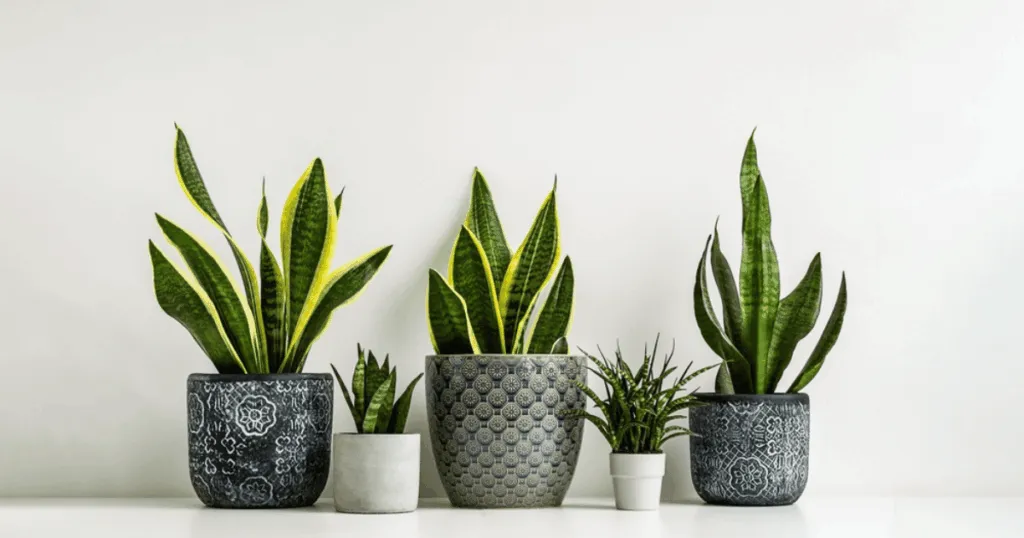
The most useful types of snake plants for offices fall into three groups: compact bird’s nest forms for desks, upright leaf varieties for floor pots, and cylindrical or broad-leaf forms for a stronger design statement. Most tolerate missed watering and ordinary office humidity well, but they do not all fit the same light level or footprint.
Start with the space you actually have. A small desk needs a compact cultivar such as Bird’s Nest, while a reception area can hold a taller striped variety such as Laurentii or Zeylanica. If the plant will sit several feet from a window under ceiling LEDs, choose a green-leaf type rather than a heavily variegated one.
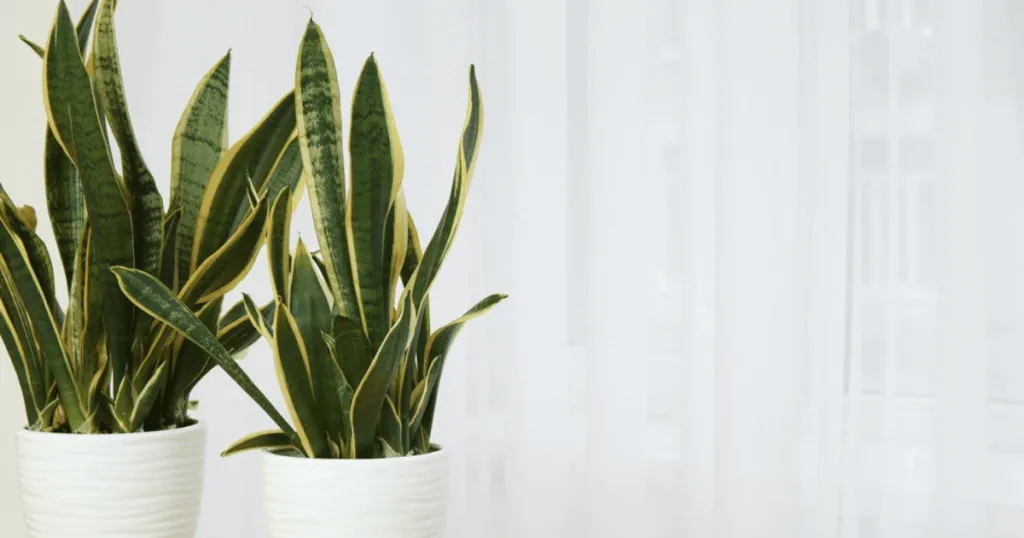
Types of Snake Plants for Office Spaces
Snake plants are commonly still sold as Sansevieria, but botanists now place them in the genus Dracaena. You may see names such as Dracaena trifasciata, Sansevieria trifasciata, or simply snake plant on the same plant label. The name difference does not change the care basics.
The broad categories below matter more than memorizing every cultivar name. Leaf width, mature size, and the amount of green tissue all affect where a plant will perform best at work.
Bird’s Nest Snake Plant for Desks and Shelves
Bird’s Nest snake plant, often labeled Dracaena trifasciata ‘Hahnii’, grows as a low rosette rather than a tall cluster of swords. Many forms stay roughly 6 to 12 inches tall, although the eventual width can be similar. It is usually the best office snake plant for a crowded desk, credenza, or shelf.
Choose a plain green Hahnii for a low-light cubicle. Gold-edged forms such as Golden Hahnii need brighter indirect light to keep their color and can become less defined under weak ceiling lighting. Keep the leaves clear of a computer’s heat exhaust and do not let water collect in the center of the rosette.
Laurentii and Zeylanica for Tall, Classic Leaves
Laurentii is the familiar snake plant with upright green leaves and yellow margins. It can reach 2 to 4 feet indoors over time, so it suits a floor planter beside a reception desk, meeting-room wall, or bright window area. Its yellow edge is attractive, but it is not the strongest choice for a windowless interior.
Zeylanica is often used for green, horizontally banded upright plants. Labels are not always used consistently in the trade, so focus on the plant rather than the name alone. A mostly green upright snake plant is generally more forgiving in low to medium office light than a yellow-edged cultivar. Put it in a stable corner where people will not brush past the leaf tips.
Moonshine and Other Silver-Green Cultivars
Moonshine has broad, pale silvery-green leaves. It looks especially clean in modern meeting rooms and white or light wood interiors. The trade-off is light: its pale color is best maintained in bright indirect light. In a dim office, new leaves may emerge greener, and growth will be very slow.
Black Coral and similar dark cultivars have deep green leaves with lighter patterning. They are more adaptable than Moonshine in medium light and can be a practical option for a lobby that has daylight from nearby windows but not direct sun. Dark-leaf varieties also hide minor dust better than pale-leaf plants, though they still benefit from occasional wiping.
Cylindrical Snake Plants for Narrow Floor Space
Cylindrical snake plants are generally sold as Dracaena angolensis, formerly Sansevieria cylindrica. Their leaves are round, rigid spears rather than flat blades. Some are sold with braided leaves, while others grow naturally upright in a fan-like clump.
These plants work well in a narrow reception corner or beside a filing cabinet because their footprint stays relatively contained. Avoid placing one in a busy walkway. The pointed leaves can be uncomfortable at eye level for a seated visitor or child. A naturally grown, unbraided plant is usually easier to assess and maintain than a tightly braided specimen, where inner leaves may be difficult to inspect.
Whale Fin Snake Plant for a Feature Spot
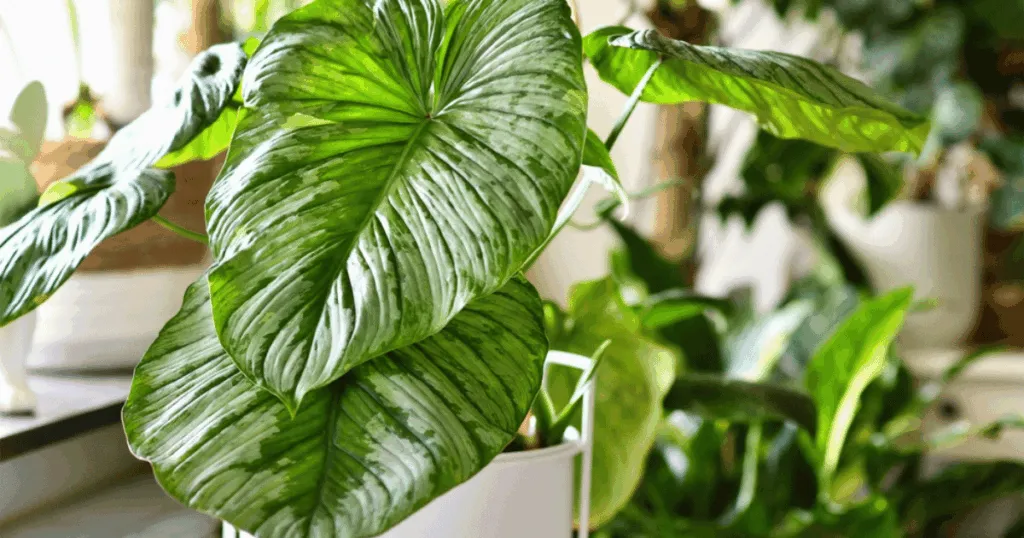
Whale Fin, usually Dracaena masoniana, has very broad paddle-shaped leaves with mottled green markings. It is a feature plant, not a desk plant. One or a few leaves can occupy substantial visual and physical space, so use it in a reception area, executive office, or open shelf with room around it.
Give Whale Fin bright indirect light for stronger growth. It will tolerate lower light for a while, but it is less suited to a deep interior than a green upright trifasciata. Its broad leaves show dust and water spots, making a regular wipe part of tidy workplace care.
Office Comparison: Size, Light, and Placement
| Type | Typical office size | Best light | Best placement | Office caution |
|---|---|---|---|---|
| Bird’s Nest, Hahnii | 6 to 12 inches tall | Low to medium | Desk, shelf, small cabinet | Keep water out of the rosette center |
| Green upright, Zeylanica type | 2 to 4 feet tall | Low to medium | Floor pot near indirect daylight | Leaves can bend if repeatedly bumped |
| Laurentii | 2 to 4 feet tall | Medium to bright indirect | Lobby, meeting room, window zone | Variegation fades in poor light |
| Moonshine | 1 to 3 feet tall | Bright indirect | Bright meeting room or reception | Often turns greener in dim rooms |
| Cylindrical, angolensis | 1 to 4 feet tall | Medium to bright indirect | Narrow floor space | Keep pointed leaves away from traffic |
| Whale Fin, masoniana | 1 to 4 feet tall and broad | Bright indirect | Feature location with open space | Too large for most desks |
Low light means enough ambient light to read comfortably during the day, even if the plant does not receive window light directly. It does not mean no light. Overhead LED or fluorescent panels can help a snake plant survive, but they rarely produce fast growth several yards from a window. If lights are off every night and all weekend, this is normal for these plants. A windowless room with lights off for extended closures is more difficult.
For offices with no meaningful daylight, a plain green Bird’s Nest or green upright variety is the safer choice. If the plant must sit more than 10 feet from a window, expect slow growth and water less often. A small dedicated grow light can help if the plant is important to the design, but it must be positioned and maintained safely for the workplace.
How to Choose the Right Snake Plant for Your Workplace
Match the plant to its real footprint
Use Bird’s Nest forms for a desk that has at least a 6 to 8 inch clear area and is not constantly moved or wiped around. For floor plants, leave clearance around the pot and leaves. A tall snake plant pushed tightly behind a chair gets damaged more often than one placed in an unused corner.
A heavy pot with a drainage hole and saucer is a practical choice for shared spaces. Snake plants dislike wet soil. Decorative cachepots without drainage are a common cause of root rot because excess water has nowhere to go. If you use one, keep the nursery pot inside it and empty pooled water after watering.
Use a watering rule that a team can follow
Most office snake plants need water about every 2 to 4 weeks in spring and summer, and every 4 to 6 weeks in winter. The schedule changes with light, temperature, pot size, and HVAC. Before watering, push a finger or wooden chopstick about 2 inches into the potting mix. Water only if it feels dry at that depth and the pot feels noticeably lighter.
For a plant beside a sunny window, check every two weeks. For one under low office light, check monthly. Assign one person to inspect it and record the date on a simple care card. Shared watering without a clear owner is riskier than a missed week. Snake plants handle a long weekend and most holiday closures far better when left dry than when heavily watered before everyone leaves.
Keep it away from office temperature stress
Snake plants prefer typical indoor temperatures of about 60 to 85°F [16 to 29°C]. Do not place one directly under an AC vent, beside a radiator, or against very cold winter glass. Cold drafts can cause soft, damaged patches, while hot dry air can lead to wrinkling and stressed leaf edges.
Move a desk plant a few feet away from a vent rather than trying to compensate with extra water. The real problem is temperature stress, not a lack of watering.
Snake Plants Around Pets, Visitors, and Children
Snake plants contain saponins. The ASPCA lists snake plants as toxic to dogs and cats. Chewing the leaves can cause gastrointestinal upset, including drooling, nausea, vomiting, or diarrhea. The sharp, upright foliage can also be a physical nuisance in a low plant stand near toddlers or pets.
Do not use any type of snake plant at floor level in a pet-friendly office where animals can reach it, or in a children’s reception area. Put it in an inaccessible room only if access is reliably controlled. For a shared space with unknown visitors and pets, choose a plant confirmed as non-toxic through a recognized veterinary or plant-safety source instead. Do not assume that a compact cultivar is safer because it is smaller. It has the same toxicity concern.
Common Mistakes With Different Snake Plant Varieties
- Buying variegation for a dark cubicle: Yellow and silver forms need more light than plain green selections. Choose green leaves for deep office interiors.
- Putting a large cultivar on a desk: Laurentii and Whale Fin may start small but need floor space as they mature. Use Hahnii for a permanent desktop role.
- Watering before a closure: A snake plant does not need a precautionary soaking before a three-day weekend. Check soil, then leave dry soil alone.
- Ignoring root crowding forever: These plants can tolerate snug roots, but a cracked pot, roots lifting the plant, or soil that dries unusually fast means it is time to repot. Move only one pot size up.
- Cleaning leaves with shine products: Wipe dust with a soft, damp cloth instead. Leaf-shine products can leave residue and make routine inspection harder.
What to Do Next With Types of Snake Plants
For a desk far from a window, start with a green Bird’s Nest snake plant in a pot with drainage. For a lobby or meeting room with indirect daylight, a green upright Zeylanica type is the most adaptable tall choice. Pick Laurentii, Moonshine, cylindrical forms, or Whale Fin only after confirming that the location has enough light and enough room for the mature plant.
Before bringing home any of these types of snake plants, decide who checks the soil, where excess water will drain, and whether pets or children can reach the leaves. Those three details will matter more than the cultivar name.
FAQ
Which snake plant is best for a desk?
Bird’s Nest snake plant, usually labeled Dracaena trifasciata ‘Hahnii’, is usually the best desk option. Its low rosette shape stays compact and is less likely to interfere with monitors or shelves. Use a pot with drainage, keep it away from direct AC airflow, and water only after the potting mix has dried at least 2 inches down.
Are Sansevieria and Dracaena the same plant?
In most office plant listings, yes. Plants long known as Sansevieria have been reclassified within the Dracaena genus. A label reading Sansevieria trifasciata and one reading Dracaena trifasciata can refer to the same basic snake plant group. Retail labels may continue using the older name because it remains widely recognized.
Can a snake plant live in an office with no windows?
A snake plant may tolerate a windowless office with reliable overhead lighting, especially a plain green variety, but it will grow slowly. It is less likely to remain healthy if all lights are off for long closures. Use a grow light if the plant is a permanent feature in a truly windowless space, and reduce watering because low light slows soil drying.
Why is my snake plant losing its yellow edge or silver color?
Weak light is a common reason variegated or pale cultivars become greener. Laurentii needs enough indirect light to maintain strong yellow margins, while Moonshine often produces greener new leaves in dim conditions. Move it closer to bright indirect daylight if possible. Do not put it into harsh direct sun suddenly, which can scorch leaves.