The most critical error in croton care is subjecting the plant to sudden environmental changes. These tropical specimens are notoriously sensitive to shifts in their surroundings, often responding to drafts, relocated positions, or temperature fluctuations by dropping their leaves in protest. Before you adjust your watering routine or move your plant to a new corner of the office, understand that stability is the foundation of a healthy croton. While they are visually striking with their variegated foliage, they demand a consistent, predictable environment to thrive in an indoor workspace.
Maintaining these plants requires a departure from the set-and-forget mentality often applied to hardier office greenery. Because they originate from tropical climates, they do not naturally adapt to the dry, climate-controlled air of modern office buildings without intentional support. When you prioritize a stable, high-light location, you provide the necessary conditions for the plant to retain its signature color patterns and structural integrity throughout the work year.
What You Need to Know
- Provide bright, direct light to maintain vibrant leaf variegation.
- Keep soil consistently moist but never waterlogged or soggy.
- Maintain high humidity levels to prevent leaf drop.
- Keep away from HVAC vents, doorways, and cold drafts.
- The plant is toxic to cats and dogs if ingested.
Optimizing Light and Placement for Color Retention
The defining feature of the croton is its intense, multi-colored foliage, which relies entirely on light intensity. In an office setting, these plants require bright, direct light to sustain their brilliant reds, yellows, and oranges. If the light levels are insufficient, the new growth will emerge as plain green, and the existing vibrant leaves may eventually fade or drop. Place your croton near a south or west-facing window where it can receive several hours of direct sunshine daily.
If your office layout does not allow for direct window placement, you must supplement with high-quality LED grow lights. Standard overhead fluorescent office lighting is rarely sufficient for a croton to maintain its color. When using artificial lighting, ensure the source is positioned close enough to the canopy to mimic the intensity of natural sun, typically within 12 to 18 inches. Avoid placing the plant in a dark corner or a windowless hallway, as the plant will quickly decline under low-light conditions.
Placement is equally about temperature stability as it is about light. Because crotons are sensitive to drafts, avoid placing them near air conditioning vents, heating registers, or frequently used exterior doors. A blast of cold air in the winter or hot, dry air from a vent in the summer will trigger the same stress response: premature leaf drop. Once you find a spot that provides both adequate light and protection from drafts, leave the plant there permanently. Moving the plant around the office to find the perfect spot often causes more harm than good.
Watering and Soil Management
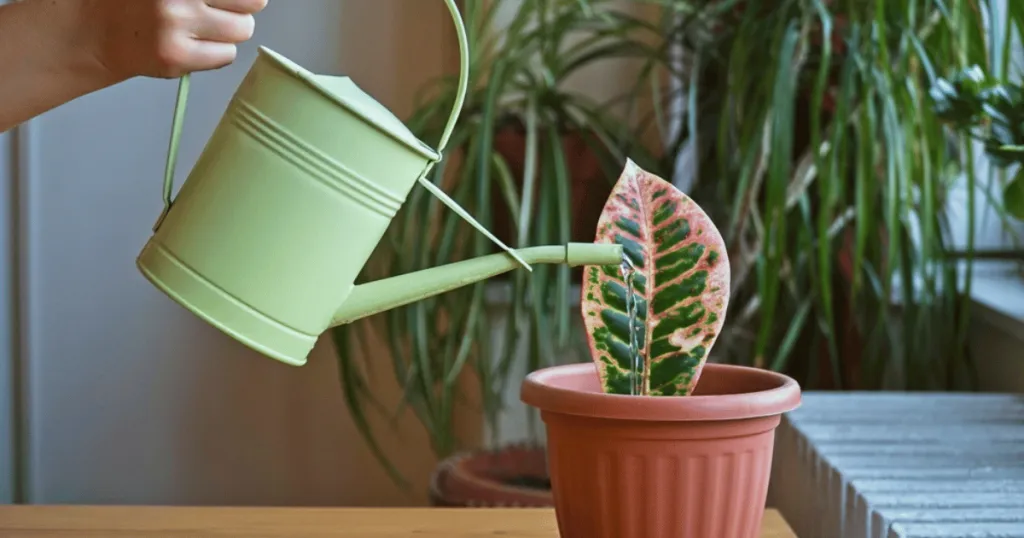
Effective croton care hinges on a delicate balance of moisture. These plants prefer soil that stays lightly moist, but they are highly susceptible to root rot if left in standing water. The goal is to keep the potting medium evenly damp, similar to the texture of a wrung-out sponge. Never allow the soil to dry out completely, as this leads to crispy leaf edges and eventual wilting. Conversely, do not let the pot sit in a saucer of water, as the roots require oxygen to function properly.
Check the soil moisture at least twice a week by inserting your finger about two inches into the potting mix. If the top inch feels dry, it is time to water. Use room-temperature water to avoid shocking the root system, as cold water can cause stress. In an office environment, it is easy to forget a plant over a three-day weekend, so ensure your pot has excellent drainage holes to prevent accidental overwatering during the work week.
The soil composition should prioritize aeration and drainage. A high-quality peat-based mix amended with perlite or orchid bark works best for office crotons. This structure allows water to pass through the root zone quickly while retaining enough moisture to keep the plant hydrated. If you notice the water sitting on the surface for too long after watering, the soil has likely become too compacted, and you should consider repotting into a fresher, more porous medium.
Humidity, Temperature, and Nutrient Needs
Office environments are notoriously dry due to HVAC systems, which creates a significant challenge for humidity-loving plants like the croton. To combat this, aim to keep the ambient humidity above 50 percent. While a pebble tray filled with water beneath the pot can provide a localized boost, the most effective method in a professional setting is often a small, dedicated humidifier nearby. Misting the leaves is a common suggestion, but it provides only fleeting relief and does not address the long-term humidity needs of the plant.
Temperature should remain stable between 65 and 80 degrees Fahrenheit. Crotons thrive in the warmth of a typical office but suffer if the temperature drops below 60 degrees. During the winter months, be particularly vigilant about nighttime temperatures near windows, as the glass can become quite cold, creating a microclimate that the plant will find inhospitable.
Feeding should be limited to the active growing season, which typically spans from spring through late summer. Use a balanced, water-soluble fertilizer diluted to half the recommended strength once a month. Do not fertilize during the autumn or winter when growth naturally slows down. Over-fertilizing in an office setting is a common mistake that leads to salt buildup in the soil, which can burn the roots and cause the leaves to brown at the tips.
Repotting, Pruning, and Propagation
Repotting is rarely needed more than once every two years. Crotons prefer to be slightly root-bound, so do not rush to move them into a much larger container. When you do repot, choose a container that is only one to two inches larger in diameter than the current one. Always use a pot with drainage holes to ensure the root system stays healthy. When moving the plant, handle the root ball gently to minimize transplant shock, which can cause the plant to drop leaves.
Pruning is essential for maintaining a bushy, attractive shape in an office space. If the plant becomes leggy or grows too tall for its designated spot, you can prune the stems back just above a leaf node. This encourages the plant to branch out and produce new, fuller growth. Always use clean, sharp shears to make precise cuts, and be aware that the plant contains a milky, irritating sap. According to ASPCA guidance on toxic plants, this sap can cause skin irritation, so it is advisable to wear gloves when pruning or handling broken stems.
Propagation is possible through stem cuttings, though it requires patience. Take a four-to-six-inch cutting from a healthy stem, remove the lower leaves, and place the stem in a container of water or moist potting mix. Keep the cutting in a warm, bright location with high humidity until roots develop. While this is a rewarding process, remember that young cuttings are even more sensitive to environmental changes than mature plants, so provide them with extra care during the rooting phase.
Seasonal Adjustments and Common Care Mistakes
Your croton care routine must adapt to the changing seasons, even within a climate-controlled office. In the summer, the plant will likely require more frequent watering due to higher temperatures and increased light intensity. Monitor the soil closely during heatwaves. In the winter, the combination of lower light and reduced growth means you should scale back on watering significantly. The biggest mistake during winter is continuing to water on a summer schedule, which almost inevitably leads to root rot.
Another common mistake is failing to clean the leaves. Dust accumulation on the broad leaves of a croton blocks light and inhibits photosynthesis. Every few weeks, gently wipe the leaves with a damp cloth. This not only keeps the plant looking professional but also helps you spot early signs of pests, such as spider mites, which are attracted to the dry conditions often found in offices. If you notice webbing or tiny spots on the undersides of the leaves, isolate the plant immediately and treat it with an appropriate horticultural soap or neem oil, following the manufacturer instructions carefully.
If your croton begins to lose leaves, do not panic, but do investigate. Leaf drop is the plant’s universal signal that something is wrong. Check for drafts, recent movement, or inconsistent watering. Often, the plant is simply reacting to a change in its environment. By returning to a consistent routine and ensuring the light, water, and temperature are stable, you can usually encourage the plant to recover and produce new foliage over time.
Advanced Troubleshooting: Managing Environmental Stress
When managing crotons in a professional space, understanding the nuances of environmental stress is key to long-term success. Unlike more forgiving foliage, crotons act as a barometer for the health of your indoor climate. If you notice the edges of the leaves turning brown and crispy, this is a classic indicator of low humidity or inconsistent watering. In an office, where HVAC systems cycle on and off, the relative humidity can fluctuate wildly. If your plant is positioned near a printer or a computer tower, the heat output from these devices can further desiccate the air, accelerating the drying process of the foliage.
Furthermore, consider the impact of ‘weekend neglect.’ In many office settings, the climate control is turned down or off over the weekend. If your croton is sitting in a drafty hallway or near a window that experiences extreme temperature swings during these off-hours, the plant will suffer. To mitigate this, ensure the plant is placed in a zone that maintains a more stable temperature profile, even when the rest of the office is unoccupied. If you find that the plant consistently struggles in a specific location, do not hesitate to move it – but do so with the understanding that it may shed leaves during the transition period as it adjusts to the new microclimate.
Finally, observe the growth rate. A healthy croton in an office should show steady, albeit slow, growth during the spring and summer. If the plant remains completely dormant for an extended period despite adequate light and water, it may be suffering from root-bound conditions that are too severe. While they like to be snug in their pots, once the roots begin to circle the bottom of the container or push the plant upward, it is time for a larger vessel. Balancing these factors – light, water, humidity, and pot size – is the hallmark of successful indoor plant maintenance for this species.
Related Croton Guides
- what the Croton is like as an office plant
- Croton symptoms and fixes
FAQ
Why are my croton leaves turning green instead of staying colorful?
The vibrant colors of a croton are a direct response to high light intensity. If your plant is turning green, it is not receiving enough light to sustain its variegation. Move the plant to a brighter location, such as a south-facing window, or supplement with a dedicated LED grow light to restore its color.
Is it normal for my croton to drop leaves when I move it?
Yes, this is a common stress response. Crotons are highly sensitive to environmental changes, including shifts in light, temperature, or placement. Even moving the plant a few feet to a new location can trigger leaf drop. Once moved, keep the plant in its new spot to allow it to acclimate.
How do I know if my office croton is getting enough water?
Check the soil moisture by inserting your finger two inches deep into the pot. If the soil is dry, it is time to water. The goal is to keep the soil consistently moist, but never soggy. If the leaves start to wilt or the edges turn crispy, your plant is likely underwatered.
Are there specific safety concerns for office pets regarding croton care?
Yes, the croton is toxic to cats and dogs. According to ASPCA guidance on toxic plants, the milky sap contains compounds that can cause irritation if the plant is chewed or ingested. If you have office pets, keep the plant in an area that is inaccessible to them to prevent accidental exposure.