African violets are a staple of office decor, prized for their ability to bloom continuously under conditions that many other flowering plants find challenging. However, the office environment presents unique hurdles, from the drying effects of central HVAC systems to the inconsistent light levels found in cubicles and meeting rooms. Successful African violet care requires moving beyond generic advice and focusing on the specific needs of these plants in a workspace where you might be away for long weekends or dealing with artificial light sources.
The most critical aspect of keeping these plants healthy is understanding that they are sensitive to temperature fluctuations and moisture levels. While they are often viewed as delicate, they are actually quite resilient if you provide them with consistent, stable conditions. By focusing on how you provide water and light, you can maintain their vibrant blooms throughout the year, even in a high-pressure workplace.
Decision Snapshot
- Light: Bright, indirect light; avoid harsh, direct window sun.
- Watering: Bottom-water only; keep soil moist, not soggy.
- Humidity: Prefers higher humidity; avoid direct HVAC vent airflow.
- Toxicity: Non-toxic to cats and dogs per ASPCA guidelines.
- Maintenance: Remove spent blooms to encourage continuous flowering.
Optimizing Light and Placement for Office Success
African violets thrive on consistency. In an office setting, this means finding a location that provides bright, indirect light for most of the day. If you are placing your plant on a desk, a north or east-facing window is usually ideal. These orientations provide enough light to stimulate flowering without the intense heat of direct afternoon sun, which can scorch the delicate, fuzzy leaves.
Many office workers rely on LED or fluorescent desk lamps to supplement natural light. This is an excellent strategy for African violets. If your office lacks a window, these plants can actually perform well under standard office lighting, provided they are positioned within a few feet of the light source. If you notice the stems becoming long and leggy, or if the leaves turn a dark, dull green, your plant is likely not receiving enough light. Conversely, if the leaves appear bleached or develop yellow patches, move the plant further from the light source or pull it away from the window.
Placement is also about protection. Avoid placing your African violet directly under or in front of an HVAC vent. The constant stream of dry, forced air will rapidly dehydrate the plant and cause the leaf edges to brown. Similarly, avoid placing the plant near exterior doors where it might be exposed to cold drafts during the winter months. A stable, moderate temperature between 65 and 75 degrees Fahrenheit is the sweet spot for these plants.
When considering office layout, think about the “weekend effect.” If your office building shuts down climate control systems on Friday evenings, the ambient temperature may drop significantly or spike depending on the season. African violets are sensitive to these shifts. If you know your office experiences extreme temperature swings, consider moving the plant to an interior desk location away from exterior walls, which tend to radiate cold or heat more intensely than internal partitions.
Watering and Soil Management
Watering is the area where most office plant owners struggle. The golden rule for African violet care is to avoid getting water on the leaves. When water droplets sit on the fuzzy foliage, they often leave unsightly white or brown spots, especially if the water is cold. This happens because the temperature difference between the water and the leaf surface causes localized cell damage.
The most effective method for office environments is bottom-watering. Place your pot in a shallow tray or saucer filled with room-temperature water for about 20 to 30 minutes. The soil will wick up the moisture it needs through the drainage holes. Once the surface of the soil feels slightly damp to the touch, remove the pot from the water and allow it to drain completely. Never leave the plant sitting in standing water, as this will quickly lead to root rot.
Regarding soil, use a specialized African violet potting mix. These mixes are formulated to be light and porous, typically containing a high percentage of peat moss or perlite. This structure is essential because it allows oxygen to reach the roots while retaining enough moisture to keep the plant hydrated. If you find the soil has become compacted over time, it will not hold water properly, and the roots may suffocate. Repotting into fresh mix every 12 to 18 months is a practical way to ensure your plant stays vigorous.
In a busy office, it is easy to forget when you last watered. To manage this, consider keeping a small log or using a simple visual cue, like a sticky note on your monitor, to track the last watering date. Because these plants prefer consistent moisture, they do not handle the “drought and flood” cycle well. If you are away for a long weekend, ensure the plant is well-hydrated before you leave, but do not leave it sitting in a deep pool of water, as the lack of airflow in a stagnant office can encourage fungal growth.
Humidity, Temperature, and Feeding
While offices are notoriously dry, African violets prefer humidity levels around 50 percent or higher. You can improve the local humidity around your plant by placing it on a tray filled with pebbles and a small amount of water. Ensure the bottom of the pot sits on the pebbles, not in the water itself. This creates a micro-climate of higher humidity as the water evaporates around the foliage.
Temperature stability is equally important. African violets are sensitive to the temperature swings that often occur in offices over the weekend. If your building turns off the heat or air conditioning on Friday nights, ensure your plant is not sitting on a cold windowsill or directly in the path of an intake vent. A consistent, moderate temperature is far better than a fluctuating one.
When it comes to feeding, use a balanced, water-soluble fertilizer specifically formulated for African violets. These fertilizers are designed to support bloom production. During the active growing season, which is typically spring through autumn, apply the fertilizer at half-strength every time you water. In the winter, you can reduce this to once a month or stop feeding entirely if the plant is not actively growing. Always ensure the soil is slightly moist before applying fertilizer to prevent root burn.
For office managers, feeding schedules can be tied to quarterly or monthly milestones to ensure consistency. Because office environments lack the natural nutrient cycling found in outdoor gardens, the limited soil volume in a pot means the plant relies entirely on you for its nutritional needs. A high-phosphorus fertilizer is often recommended for these plants to encourage the vibrant blooms that make them such popular desk companions.
Pruning, Repotting, and Propagation
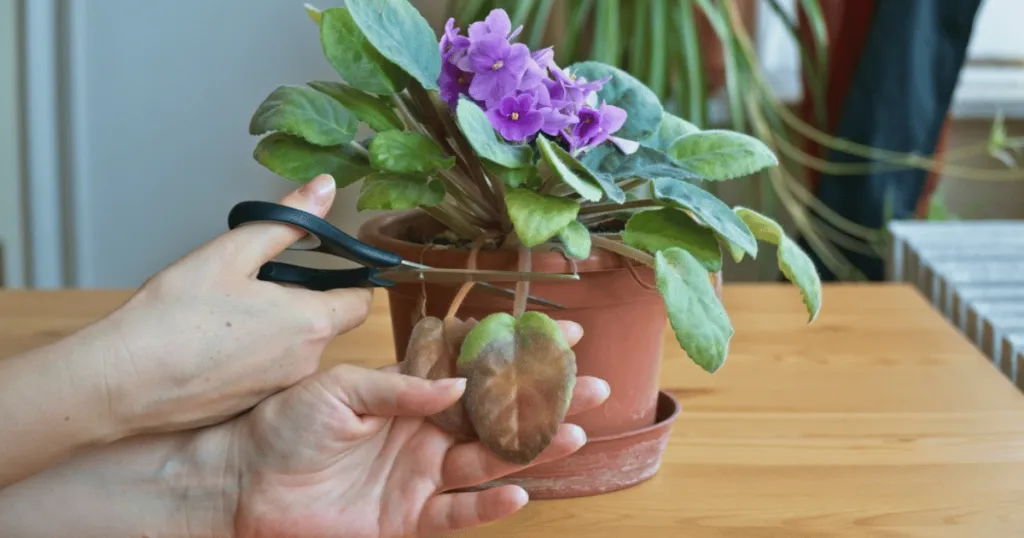
Pruning is a simple but essential task. Regularly remove dead or yellowing leaves from the base of the plant to improve airflow and direct energy toward new growth. If you notice spent flowers, pinch them off at the base of the stem. This prevents the plant from putting energy into seed production and encourages it to produce new buds.
Repotting is necessary when the plant becomes root-bound or the soil loses its structure. You will know it is time to repot if the plant seems to stop growing or if the roots are circling the bottom of the pot. Choose a pot that is only slightly larger than the current one; African violets actually prefer to be somewhat snug in their containers. A pot that is too large will hold too much water, increasing the risk of root rot.
Propagation is a rewarding way to share plants with colleagues. You can easily grow a new African violet from a single healthy leaf. Cut a leaf with about an inch of stem attached and place it in a small container of moist, porous potting mix. Cover the container with a clear plastic bag to create a humid environment and place it in bright, indirect light. Within a few weeks, you should see tiny plantlets emerging from the base of the leaf, which can then be separated and potted individually. This is a great way to build a small collection of plants for your workspace without additional costs.
When pruning, always use clean, sharp scissors to avoid introducing pathogens into the plant tissue. In an office, where air circulation can be poor, open wounds on a plant are susceptible to rot if the humidity is too high or if the plant is handled frequently by others. Always sanitize your tools between plants if you are maintaining a collection of several violets.
Seasonal Adjustments and Common Mistakes
Your care routine should shift slightly with the seasons. In the winter, light levels are lower and growth slows down. You should reduce your watering frequency and stop fertilizing. During the summer, the plant may grow faster and require more frequent watering and consistent feeding. Always monitor the soil moisture rather than sticking to a rigid calendar schedule, as office conditions can change based on building occupancy and weather.
The most common mistake is overwatering. Many office workers water their plants out of habit or as a way to engage with their desk environment. If you are unsure whether to water, wait another day. It is much easier to revive a slightly dry African violet than one with waterlogged, rotting roots. Another frequent error is using cold tap water. Always let your water sit for an hour or two so it reaches room temperature before applying it to the soil.
Healthy growth in an African violet is characterized by dark green, fuzzy leaves arranged in a symmetrical rosette, with flowers held proudly above the foliage. If the plant looks sparse, has yellowing leaves, or refuses to bloom, check your light levels first. If the light is sufficient, check the soil moisture. Often, a simple adjustment to your watering technique or a move to a brighter spot on your desk is all it takes to restore your plant to health.
Finally, be mindful of the “office traffic.” If your plant is located on a high-traffic desk or near a shared workspace, it may be subject to accidental bumps or debris. Keeping the plant slightly elevated or in a dedicated corner can protect the delicate leaves from physical damage. Remember that the goal is to create a low-stress environment that mimics the plant’s natural, sheltered habitat, allowing it to focus its energy on producing those iconic, colorful blooms that brighten up the workday.
Related African Violet Guides
- our African Violet overview
- African Violet symptoms and fixes
FAQ
Why are the leaves on my African violet turning brown and spotting?
This is almost always caused by cold water touching the leaves. African violets are sensitive to temperature shocks. To prevent this, always use room-temperature water and ensure you are only watering the soil directly, never splashing the foliage.
Can I keep my African violet in a windowless office?
Yes, African violets are excellent candidates for office lighting. They perform well under standard fluorescent or LED desk lamps. Ensure the plant is within 12 to 18 inches of the light source for at least 8 to 10 hours a day to encourage consistent blooming.
Is it safe to keep an African violet around office pets?
According to the ASPCA, African violets are non-toxic to both cats and dogs. This makes them a safe choice for offices that allow pets or for your home workspace if you have curious animals.
How do I know if my African violet is getting enough light?
A healthy plant will have compact, dark green leaves. If the stems become long and leggy, or the plant stops producing flowers, it is likely not receiving enough light. Move it closer to your desk lamp or a brighter window area.