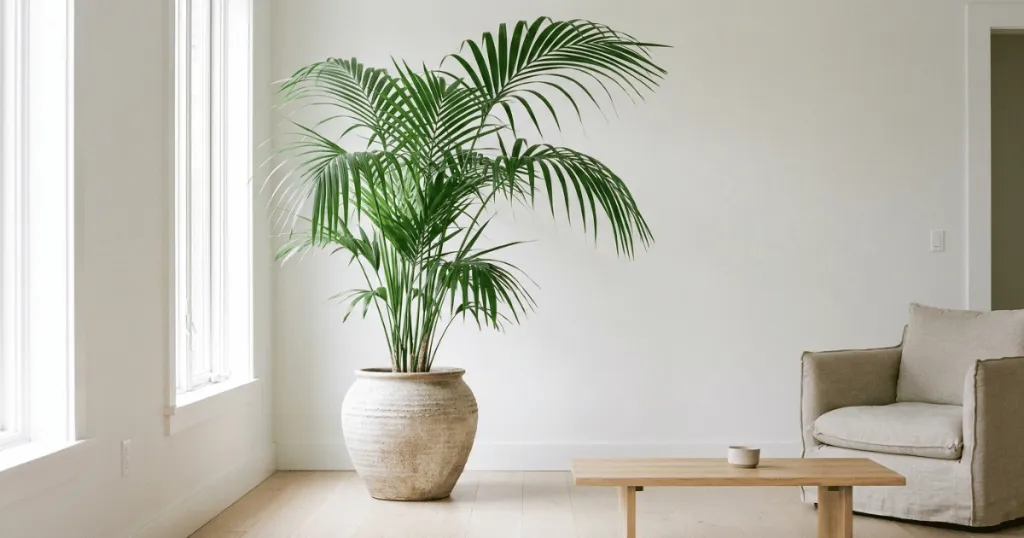
The Kentia palm (Howea forsteriana) stands as the gold standard for corporate environments, offering a sophisticated, architectural silhouette that few other indoor plants can match. Unlike faster-growing palms that quickly outgrow their pots or become unruly in tight office corridors, the Kentia is a slow-growing, resilient specimen that maintains its form over many years. Its ability to tolerate the specific challenges of a workplace – such as artificial lighting and fluctuating HVAC temperatures – makes it a top choice for office managers looking to elevate reception areas or executive suites without the high-maintenance demands of more temperamental tropicals.
Decision Snapshot
- Light: Thrives in medium to bright indirect light; tolerates low light.
- Watering: Allow the top inch of soil to dry between waterings.
- Humidity: Performs well in standard office humidity levels.
- Toxicity: Non-toxic to cats and dogs per ASPCA guidance.
- Difficulty: Moderate; ideal for reception areas and meeting rooms.
Achieving success with Kentia palm care involves moving away from traditional gardening habits toward a more restrained, consistent approach. Because these plants are native to the Lord Howe Island region, they are accustomed to stable, mild conditions. In an office setting, your primary goal is to mimic this stability. By prioritizing consistent light exposure and avoiding the common pitfall of over-saturation, you can keep your Kentia palm healthy, dark green, and structurally sound for years to come.
Light Requirements and Strategic Placement
Kentia palms are remarkably adaptable, but their growth rate and overall vigor are directly tied to the quality of light they receive. While they are frequently marketed as low-light survivors, it is more accurate to view them as low-light tolerant. In a dim corner of an office with only minimal fluorescent light, the plant will survive, but it will not thrive or produce new fronds at a meaningful rate. For the best results in a professional setting, aim for a location that provides bright, indirect light.
If you are placing your palm in a lobby or reception area, look for spots near north-facing or east-facing windows where the plant can receive soft, filtered morning light. Avoid placing the Kentia directly in the path of harsh, afternoon sun, especially if the window lacks UV-filtering film. Intense direct rays can scorch the delicate leaflets, leaving unsightly brown patches that do not recover. If your office layout forces the plant into a windowless interior room, ensure the plant is positioned beneath or near high-output LED or full-spectrum lighting fixtures to compensate for the lack of natural solar energy.
Rotation is a key, yet often overlooked, aspect of Kentia palm care. Because office plants are usually viewed from multiple angles, you want to encourage even, symmetrical growth. Every time you perform a routine maintenance check, rotate the pot by a quarter turn. This prevents the fronds from leaning heavily toward the light source, which can eventually cause the plant to become lopsided or top-heavy. If the palm is in a heavy decorative planter, consider using a plant dolly to make this rotation effortless for your facilities team.
Watering and Soil Management
The most frequent cause of decline in office Kentia palms is not a lack of care, but rather an excess of it. These palms prefer a consistent moisture level, but they are highly susceptible to root rot if left sitting in stagnant water. The rule of thumb for watering is to allow the top inch of the soil to dry out completely before adding more water. In an office environment, where humidity is often lower due to central heating and air conditioning, the soil may dry out faster than you expect, but you must verify this with a physical check rather than a calendar schedule.
To check the moisture level, insert your finger or a wooden dowel about one to two inches into the soil. If the soil feels damp or cool, hold off on watering. If it feels dry and crumbly, it is time to provide a thorough soak. When you do water, ensure that the water reaches the entire root ball, but do not let the plant sit in the drainage saucer for more than a few minutes. Excess water left in the saucer can wick back into the soil, creating a soggy environment that suffocates the roots.
Soil selection is equally vital. Use a high-quality, well-draining indoor potting mix that contains perlite or pumice to improve aeration. A heavy, dense soil will hold onto moisture for too long, which is a recipe for failure in an office setting. If your Kentia is in a large, deep container, ensure the bottom of the pot has adequate drainage holes. If you are using a decorative outer pot that lacks holes, keep the plant in its original nursery liner and place that inside the decorative container, using a layer of gravel or a riser to ensure the plant is not resting in a pool of water at the bottom.
Humidity, Temperature, and Feeding
Kentia palms are surprisingly forgiving regarding humidity, which makes them excellent candidates for climate-controlled office spaces. While they appreciate the higher humidity found in tropical environments, they do not require the constant misting or pebble trays that more sensitive ferns might need. Average office humidity levels, typically between 30 and 50 percent, are perfectly acceptable for a healthy Kentia. If your office is exceptionally dry during the winter months, you may notice the tips of the fronds turning brown, but this is usually a cosmetic issue that does not threaten the plant’s long-term survival.
Temperature stability is far more important than humidity. Kentia palms prefer temperatures between 65 and 80 degrees Fahrenheit. The most dangerous locations in an office are directly in the path of HVAC vents or near exterior doors that admit cold drafts during the winter. A constant stream of hot or cold air will stress the plant and cause premature leaf drop. If you must place a plant near a vent, use a deflector to redirect the airflow away from the foliage.
Feeding should be done with a light hand. Because the Kentia is a slow grower, it does not require heavy doses of fertilizer. Use a balanced, water-soluble fertilizer formulated for indoor foliage plants, diluted to half the recommended strength. Apply this during the growing season, which typically spans from early spring through late summer. Avoid fertilizing in the winter when the plant is in a state of semi-dormancy. Over-fertilizing can lead to a buildup of salts in the soil, which can burn the roots and cause yellowing of the fronds.
Repotting, Pruning, and Propagation
Repotting a Kentia palm is a task that should be approached with patience. These plants do not like having their roots disturbed, and they are perfectly content being slightly root-bound. You will likely only need to repot your palm every three to four years. When you do repot, choose a container that is only one or two inches wider in diameter than the current one. Moving to a pot that is too large creates a volume of soil that stays wet for too long, which often leads to root rot.
Pruning is primarily a task of aesthetics and hygiene. As the plant ages, the lowest fronds will naturally turn yellow and then brown as they die off. This is a normal part of the plant’s life cycle. Use clean, sharp pruning shears to remove these spent fronds, cutting them close to the main stem without damaging the trunk. Never prune away green, healthy fronds, as the plant relies on these to produce the energy it needs to grow. If you notice a brown tip on an otherwise healthy leaf, you can trim the brown portion off, but be sure to follow the natural shape of the leaflet to keep the plant looking professional.
Propagation of Kentia palms is generally not practical for an office environment. These palms are typically grown from seeds, and the process is extremely slow and requires specialized conditions that are rarely available in a workplace. If you need more plants for your office, it is far more efficient to purchase established specimens from a reputable nursery. Attempting to propagate from existing office plants is likely to lead to frustration and poor results.
Seasonal Adjustments and Common Mistakes
While office environments are relatively stable, seasonal changes can still impact your Kentia palm. During the winter, the reduced natural light and the increased use of heating systems mean that the plant will require less water. Always adjust your watering frequency based on the season. If the office is closed for an extended holiday period, ensure that the plant is not left in a location where the temperature will drop significantly or where the soil will completely dry out to the point of dehydration.
The most common mistake in Kentia palm care is over-watering. It is much easier to revive a slightly dry palm than one that has suffered from root rot. If you see yellowing fronds, it is often a sign that the soil is staying too wet. If the tips are brown and crispy, the plant may be suffering from low humidity or inconsistent watering. Another common error is using leaf shine products on the fronds. These products can clog the pores of the leaves and interfere with photosynthesis. Instead, keep the leaves clean by gently wiping them with a soft, damp cloth to remove dust, which allows the plant to absorb light more efficiently.
Healthy growth in a Kentia palm is characterized by deep green, arching fronds and a steady, albeit slow, production of new growth from the center of the crown. If your plant is maintaining its color and the fronds are firm, you are likely providing the correct care. If the plant begins to lean excessively, increase your rotation frequency. If the fronds appear pale or washed out, the plant is likely not receiving enough light. By observing these subtle cues, you can make minor adjustments that ensure your Kentia remains a centerpiece of your office for many years.
Related Kentia Palm Guides
- the Kentia Palm plant guide
- common Kentia Palm problems
FAQ
Is the Kentia palm safe to have in an office with pets?
Yes. According to the ASPCA, the Kentia palm is non-toxic to cats and dogs. This makes it an excellent, worry-free choice for offices that allow pets or for reception areas where visitors may bring animals.
Why are the tips of my Kentia palm leaves turning brown?
Brown tips are usually a sign of low humidity or inconsistent watering. In an office, check if the plant is near a heater or air vent that is drying out the air. Ensure you are watering thoroughly when the top inch of soil is dry, rather than giving the plant small, frequent sips.
How often should I fertilize my Kentia palm in the office?
Because Kentia palms are slow growers, they require very little fertilizer. A balanced, water-soluble fertilizer applied at half-strength once a month during the spring and summer is sufficient. Do not fertilize during the autumn or winter months.
Can a Kentia palm survive in a windowless office?
While it can survive in low light, it will not thrive without a light source. If your office lacks windows, you must place the palm under high-quality, full-spectrum LED lighting to ensure it receives enough energy to maintain its health and color.