Maintaining a vibrant workspace often hinges on selecting plants that adapt well to the specific limitations of an office environment. The bird’s nest fern, known botanically as Asplenium nidus, is a standout choice for desks and reception areas because it thrives in the exact conditions that many other tropical plants find challenging. Unlike more delicate ferns that require high-intensity light or constant misting, this species is remarkably resilient when placed in typical office settings with moderate, indirect light and consistent, controlled temperatures.
The primary key to success with this plant is balancing the need for consistent moisture against the reality of indoor air. Because office HVAC systems often strip moisture from the air, your approach to bird’s nest fern care must prioritize maintaining a stable root environment while preventing the foliage from drying out. When you provide the right baseline of care, this plant rewards you with its signature rosette of bright, apple-green fronds that add a structural, architectural element to any professional space.
Decision Snapshot
- Light: Thrives in low to medium indirect office light.
- Watering: Keep soil lightly moist; never allow complete drying.
- Humidity: Prefers higher levels; avoid placement near direct vents.
- Toxicity: Non-toxic to cats and dogs per ASPCA guidance.
- Difficulty: Moderate; requires consistency over intensity.
Light and Placement in the Office
In an office, light is rarely uniform. You might have a window-side desk with bright, filtered light or a cubicle illuminated entirely by overhead LEDs. The bird’s nest fern is highly adaptable, making it a reliable performer in both scenarios. Its natural habitat involves growing on the branches of trees in tropical rainforests, which means it is accustomed to filtered light rather than the harsh, direct sun that would scorch its delicate fronds.
For the best results, position your fern where it receives bright, indirect light. If you are near a window, ensure the plant is shielded by a sheer curtain or placed a few feet back so that direct sun rays do not hit the leaves. Prolonged exposure to direct sunlight will cause the fronds to bleach, turn yellow, or develop brown, crispy edges that cannot be repaired.
Conversely, if your office relies on artificial lighting, this plant can tolerate lower light levels quite well. If you notice the plant is growing very slowly or the fronds are becoming thin and sparse, move it slightly closer to your light source, but avoid sudden shifts that could shock the root system.
Avoid placing your plant directly under or in front of HVAC vents. The constant stream of dry, forced air acts like a blow-dryer on the foliage, rapidly depleting the moisture the plant needs to maintain its turgor pressure. A stable, draft-free corner or a spot on a desk away from air intake grilles is ideal.
Watering and Soil Guidance
Watering is the most critical aspect of bird’s nest fern care. Because these plants are epiphytic in nature, they appreciate a potting medium that holds moisture but remains aerated. A standard, high-quality indoor potting mix amended with a bit of perlite or orchid bark works well to ensure that excess water drains away from the roots, preventing the soggy conditions that lead to root rot.
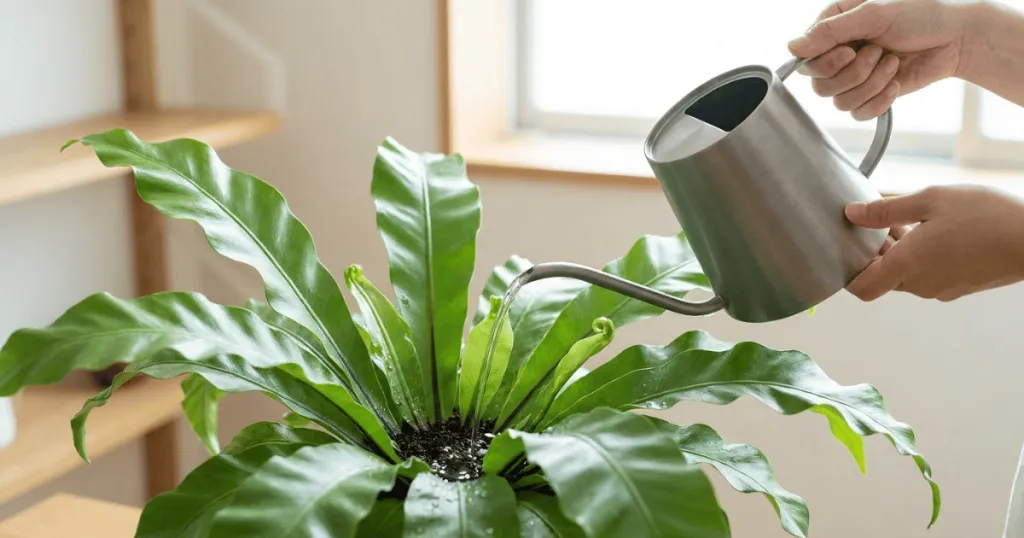
When watering, aim to keep the soil lightly moist to the touch. The goal is to avoid extremes. If the soil dries out completely, the fronds will begin to droop and lose their crisp, upright appearance. If the soil remains waterlogged, the roots will suffocate. A practical rule is to check the top inch of soil with your finger once or twice a week. If it feels dry, it is time to water. Always water at the base of the plant, directing the stream toward the soil rather than pouring water into the center of the rosette.
Pouring water into the crown can trap moisture in the tight cluster of new growth, which often leads to fungal issues or crown rot in office environments where air circulation is limited.
If you are away for a weekend or a holiday, ensure the plant is thoroughly watered before you leave. Because office temperatures are usually kept stable, the plant will not dry out as quickly as it might in a home environment, provided it is not sitting in a drafty area.
Humidity, Temperature, and Feeding
While the bird’s nest fern is more tolerant of lower humidity than other fern species, it still appreciates an environment that mimics its tropical origins. Office air is notoriously dry, which can lead to brown, brittle leaf tips. If you notice this happening, you can increase the local humidity by placing the plant on a tray filled with pebbles and a shallow layer of water. Ensure the bottom of the pot is sitting on the pebbles, not submerged in the water, to prevent root rot.
Temperature-wise, these plants prefer the same range that humans find comfortable, typically between 65 and 75 degrees Fahrenheit. They are sensitive to cold drafts, so keep them away from exterior doors or windows that may be opened during winter months. Sudden temperature fluctuations can cause the plant to drop older fronds prematurely.
Feeding is straightforward. During the growing season, which generally spans from spring through early autumn, apply a balanced, water-soluble fertilizer diluted to half-strength once a month. Do not fertilize during the winter months when growth naturally slows down. Over-fertilizing can lead to salt buildup in the soil, which will eventually damage the roots and manifest as yellowing or browning on the leaf edges.
Managing Environmental Stress in Open Offices
Open-plan offices present unique challenges for plant physiology. The high volume of foot traffic and the constant movement of air can create micro-climates that shift throughout the day. For the bird’s nest fern, stability is the ultimate goal. If your desk is located in a high-traffic area, consider placing the plant on a slightly elevated stand or a shelf where it is protected from accidental bumps. Physical damage to the fronds can lead to permanent scarring, as these plants do not “heal” damaged leaf tissue; they simply grow new ones.
Furthermore, consider the impact of office lighting schedules. If your office uses automated lighting that shuts off completely at night, the plant will adapt, but ensure that it still receives enough ambient light during the day to support photosynthesis. If the plant is in a cubicle with no natural light, consider a small, dedicated LED grow light. These are often compact enough to clip onto a shelf or sit on a desk, providing the specific spectrum needed for foliage health without the intensity of direct sunlight.
Repotting, Pruning, and Propagation
Bird’s nest ferns are relatively slow growers, so you will not need to repot them often. Generally, once every two to three years is sufficient. When you do repot, choose a container that is only one to two inches larger in diameter than the current one. Using a pot that is too large can lead to excess soil remaining wet for too long, which is a common cause of failure for indoor ferns. When selecting a pot, prioritize drainage; a pot without a drainage hole is a significant risk in an office setting where you cannot easily tip out excess water.
Pruning is mostly a matter of aesthetics and plant health. As the plant matures, the oldest fronds at the base of the rosette may naturally yellow and wither. You can cleanly snip these off at the base with sterilized scissors to keep the plant looking tidy and to redirect its energy toward new growth. Never pull the fronds off, as this can damage the crown of the plant. If you notice a frond that is damaged or browning, prune it back to the base to prevent the plant from wasting resources on dying tissue.
Propagation for the bird’s nest fern is best left to experienced growers, as it typically involves spores rather than simple stem cuttings. For most office managers, the best way to expand your collection is to purchase established plants. If you find a plant that has multiple distinct crowns, you may be able to divide it during repotting, but this is a delicate process that carries a risk of losing the plant if the roots are damaged too severely.
Seasonal Notes and Common Care Mistakes
Your bird’s nest fern will experience subtle shifts in growth throughout the year. In the winter, growth will slow significantly due to shorter days and lower light intensity. During this time, reduce your watering frequency. The soil will take longer to dry out, and keeping it too wet during the winter is a common mistake that leads to root decline. Monitor the soil moisture more closely during the colder months, as the reduced metabolic rate of the plant means it consumes less water.
The most frequent error in bird’s nest fern care is over-watering or allowing water to pool in the center of the crown. If you notice the center of your plant turning mushy or dark brown, you have likely trapped too much moisture in the crown. Another common mistake is ignoring the plant’s need for consistent, if moderate, humidity.
If the fronds look dull or the edges are consistently crispy despite regular watering, the ambient humidity is likely the culprit. Finally, avoid the urge to mist the leaves frequently. While it seems helpful, misting provides only a fleeting spike in humidity and can encourage bacterial growth on the foliage if the air does not circulate well enough to dry the leaves quickly.
Healthy growth is characterized by firm, glossy, bright green fronds that unfurl from the center in a tight, healthy spiral. If your plant is producing new fronds regularly, you have found the right balance of light and moisture for your specific office spot. Always observe the plant’s reaction to its environment; if the fronds begin to lean heavily in one direction, it is a clear indicator that the plant is reaching for more light, and you should adjust its position accordingly.
Related Bird’s Nest Fern Guides
- what the Bird’s Nest Fern is like as an office plant
- Bird’s Nest Fern symptoms and fixes
FAQ
Why are the tips of my bird’s nest fern fronds turning brown?
Brown tips are most often caused by low humidity or inconsistent watering. Office environments are frequently dry, which pulls moisture from the frond tips. Try placing the plant on a pebble tray with water to boost local humidity, and ensure you are not letting the soil dry out completely between waterings.
Can I keep my bird’s nest fern in a windowless office?
Bird’s nest ferns require some light to survive. If your office has no windows, the plant will likely struggle unless it is placed directly under a dedicated full-spectrum grow light. Standard office fluorescent lights may keep it alive for a short time, but it will eventually decline without a more consistent light source.
Is it safe to keep a bird’s nest fern near my office pet?
Yes, the bird’s nest fern is considered non-toxic to cats and dogs according to ASPCA guidance. This makes it a safe choice for shared office spaces where pets might occasionally be present, though it is still best to keep the plant out of reach to prevent physical damage to the fronds.
Should I mist my bird’s nest fern to help it grow?
While misting is a common recommendation, it is often ineffective in offices and can actually lead to fungal issues if the water sits on the leaves for too long. Instead of misting, focus on maintaining consistent soil moisture and using a humidity tray to create a better microclimate around the base of the plant.