When workplace decision-makers look to green up a workspace, a common point of confusion is whether standard fluorescent tubes or overhead LED panels provide enough energy for living greenery. The short answer is no, not all vegetation can survive indoors. Understanding how office lighting interacts with foliage helps managers avoid costly mistakes and maintain healthy plants.
Navigating workplace biology requires looking past the visual brightness of a corporate suite and analyzing the actual physical environment experienced by indoor foliage. Office managers and facilities teams often assume that if a space feels bright enough for human tasks, it is bright enough for botanical life. However, human eyes compensate for dim conditions in ways that plant chloroplasts simply cannot, making a structured approach to selection essential for long-term survival.

Understanding Indoor Office Light Spectra and Intensity
Artificial lighting in commercial buildings is engineered for human productivity, not for photosynthesis. While standard fixtures illuminate workspaces efficiently, they emit a much narrower light spectrum and significantly lower intensity than natural sunlight. This mismatch is why many species struggle or decline within weeks of being brought inside.
Foot-candles and lumens are standard measurements used to evaluate illumination levels. A typical windowless corporate interior might register between thirty and fifty foot-candles of light at desk level, whereas a bright sunlit windowsill can exceed several thousand foot-candles. Foliage adapted to tropical understories can manage low foot-candle environments, but sun-loving outdoor varieties will quickly exhaust their stored energy reserves and die.
When assessing office plant lighting requirements, it is vital to evaluate both the duration and the quality of the illumination. Light fixtures that remain off during evenings and weekends drastically reduce the daily light integral, meaning plants receive fewer total photons over the course of a week. This restriction heavily impacts metabolic processes, forcing office managers to select specimens that naturally endure intermittent energy supplies without dropping their leaves.
Fluorescent Versus LED Fixtures
Linear fluorescent tubes have long been the backbone of commercial interiors. Older T8 and T12 bulbs provide a broad enough spectrum for hardy low-light species, provided the fixtures remain on for ten to twelve hours daily. Modern LED panels, increasingly standard in new builds, offer superior energy efficiency and directional illumination. Many newer office LEDs feature balanced white light spectra that support resilient indoor foliage far better than aging fluorescent setups, though intensity still drops off rapidly with distance from the ceiling.
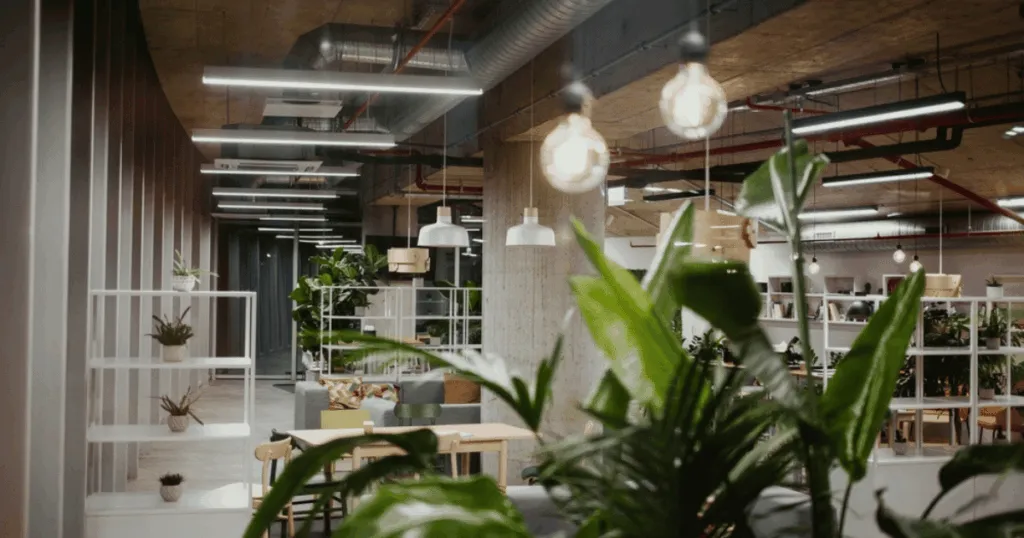
Evaluating fluorescent office lighting versus modern LED office panels reveals clear operational trade-offs for facilities teams. Traditional fluorescent tubes degrade in spectral output over time long before they completely burn out, leaving plants under an imperceptible dimming condition. On the other hand, commercial LED systems maintain stable output and directional focus, preventing light from scattering wastefully across open office ceilings.
The Problem With Windowless Interior Zones
Core conference rooms and interior workstations often lack any direct natural light exposure. In these settings, plants rely entirely on artificial illumination. If overhead lights are turned off during weekends and holidays, foliage may experience periods of complete darkness lasting forty-eight hours or longer. Selecting resilient varieties that tolerate both low illumination and intermittent photoperiods is essential for long-term survival in windowless spaces.
Finding suitable plants for windowless offices demands careful auditing of corporate operating hours. In buildings where automated timers or motion sensors shut down ceiling grids overnight and throughout the weekend, botanical specimens must endure prolonged dark cycles. Species with thick cellular structures and slow respiration rates adapt much better to these prolonged pauses in energy generation than fast-growing varieties.
Which Species Tolerate Artificial Illumination Best
Certain resilient cultivars have evolved in shaded jungle floors or developed physiological adaptations that allow them to process low-intensity, artificial wavelengths efficiently. When evaluating options for desks, reception areas, and open offices, facilities managers should look beyond mere survival and consider actual aesthetic endurance.
Deploying reliable low light office plants across administrative areas guarantees that corporate interiors maintain a vibrant appearance without demanding specialized horticultural labor. These robust cultivars manage to perform basic photosynthesis indoors under restricted office lighting by maximizing their remaining chloroplast efficiency.
- ZZ Plant (Zamioculcas zamiifolia): Known for storing moisture in thick rhizomes, this species tolerates dim corners and erratic watering schedules with ease.
- Snake Plant (Sansevieria trifasciata): An exceptionally tough candidate that manages low foot-candle readings and dry HVAC air without dropping leaves.
- Cast Iron Plant (Aspidistra elatior): True to its name, it withstands neglect, low illumination, and fluctuating temperatures better than most delicate ferns.
- Pothos (Epipremnum aureum): A vigorous trailing option that adapts well to fluorescent office environments, though variegation may fade in extremely dim spots.
Evaluating Foliage Requirements Versus Room Realities
Before placing greenery in an open office, check the actual distance between the ceiling fixtures and the plant canopy. Light intensity decreases exponentially with distance according to the inverse square law. A fixture that provides adequate lumens at desktop height may leave a floor-standing container in near-total darkness. Positioning containers on high shelves, file cabinets, or desks often bridges the gap between dim floor levels and usable illumination.
Understanding how light intensity and light spectrum interact with indoor foliage prevents common placement errors. When a container sits too far below a ceiling fixture, the upper leaves cast shadows on lower foliage, compounding the energy deficit. Keeping plants elevated or directly underneath architectural downlights ensures that every tier of leaves receives a share of the available photons.
When analyzing specific workspace constraints, facilities planners must also account for architectural shadows cast by structural columns, hanging acoustic baffles, and tall partition walls. These physical barriers can block lateral light from spreading across a room, creating micro-zones of near-total darkness right next to moderately lit desks. Office managers should map out these shadow zones before purchasing decorative containers, ensuring that every plant is positioned directly under an unblocked cone of artificial illumination rather than tucked away in unlit architectural dead zones.
Practical Strategies for Sustaining Workspace Greenery
Managing indoor flora requires facilities teams to navigate artificial illumination limits alongside other workplace stressors like dry HVAC air, weekend neglect, and restricted watering access. Establishing a routine care protocol prevents common decline patterns.
A common mistake is assuming that low illumination means low water requirements. While reduced light slows down metabolic rates and soil drying times, office HVAC systems generate constant airflow that rapidly evaporates moisture from the surrounding air. Checking soil dampness manually rather than relying on a rigid calendar schedule prevents both under-watering and root rot caused by stagnant conditions.
Maintaining proper humidity control and monitoring HVAC airflow are critical operational steps for office managers. Constant drafts from commercial heating and cooling units can dehydrate leaves even when the soil feels moist to the touch. Factoring in the natural photoperiod of the workspace ensures that watering schedules align with the periods when plants are actively processing energy rather than remaining dormant in darkness.
Addressing Supplementary Lighting Solutions
When interior spaces lack adequate lumens, supplementing with dedicated horticultural LED bulbs can transform a failing display into a thriving feature. Full-spectrum desk lamps or under-shelf fixtures designed for indoor gardening provide the necessary wavelengths without disrupting the professional aesthetic of the office. These additions are particularly useful for reception desks located far from exterior windows.
Integrating auxiliary light sources helps bridge the gap in windowless zones where baseline office lighting falls short of biological minimums. By choosing sleek, architectural supplementary lamps that blend seamlessly with corporate decor, facilities teams can support healthy green displays in areas that would otherwise destroy living vegetation within weeks.
Making the Right Plant Choices for Your Workspace
Determining whether will any plants grow in office light depends entirely on matching the specific cultivar to the actual illumination level of the intended spot. Avoid guessing light levels by observing how long fixtures remain active and whether natural daylight reaches the interior zones. Prioritizing hardy, shade-tolerant species ensures a sustainable, low-maintenance green office environment that enhances the workplace without demanding constant replacement.
Successful indoor planting ultimately relies on disciplined planning and realistic expectations. By assessing workspace constraints honestly – such as distance from ceiling fixtures, weekend shutdowns, and continuous HVAC drafts – office managers can create lasting installations that elevate employee morale and improve the visual appeal of professional interiors without requiring constant troubleshooting.
FAQ
Do office plants need direct sunlight to survive?
No, many popular office varieties originate from tropical rainforest understories where they receive filtered, indirect light. They can adapt to artificial fluorescent or LED lighting, provided the intensity and daily duration meet their minimum energy thresholds.
What happens to plants when office lights are turned off over the weekend?
Most resilient indoor species handle weekend darkness without permanent damage because their metabolic processes slow down significantly. However, species requiring higher light levels may show signs of stress or leaf drop if deprived of illumination for consecutive days.
How can I tell if my office lighting is too dim for a plant?
Signs of insufficient light include stretched or leggy growth, rapid yellowing of lower leaves, lack of new growth over several months, and fading of variegation on patterned foliage. If you cannot comfortably read a book in that spot without artificial aid, most plants will struggle.