The bamboo palm, scientifically known as Chamaedorea seifrizii, is one of the most reliable choices for office settings. Unlike many tropical plants that struggle with the artificial environment of a commercial building, this species is remarkably forgiving. It is not a true bamboo, but rather a clustering palm that thrives in the filtered light and consistent temperatures typical of indoor workspaces. For office managers and employees, the primary takeaway for successful bamboo palm care is consistency: maintaining a steady moisture level in the soil and avoiding the harsh, direct sun that can scorch its delicate fronds.
Because it is naturally adapted to the forest understory, this palm handles the lower light levels of cubicles and meeting rooms better than most other indoor palms. While it is easy to maintain, it does require a specific approach to watering and humidity to prevent common issues like brown tips or stunted growth. By understanding its basic needs, you can enjoy a lush, green aesthetic that improves air quality without the constant demand for specialized attention.
Quick Facts
- Light: Thrives in medium indirect light; tolerates low light.
- Watering: Keep soil lightly moist; never allow complete dryness.
- Humidity: Prefers average to above-average indoor humidity levels.
- Difficulty: Easy to moderate for most office environments.
- Toxicity: Non-toxic to cats and dogs per ASPCA guidance.
Optimizing Light and Placement
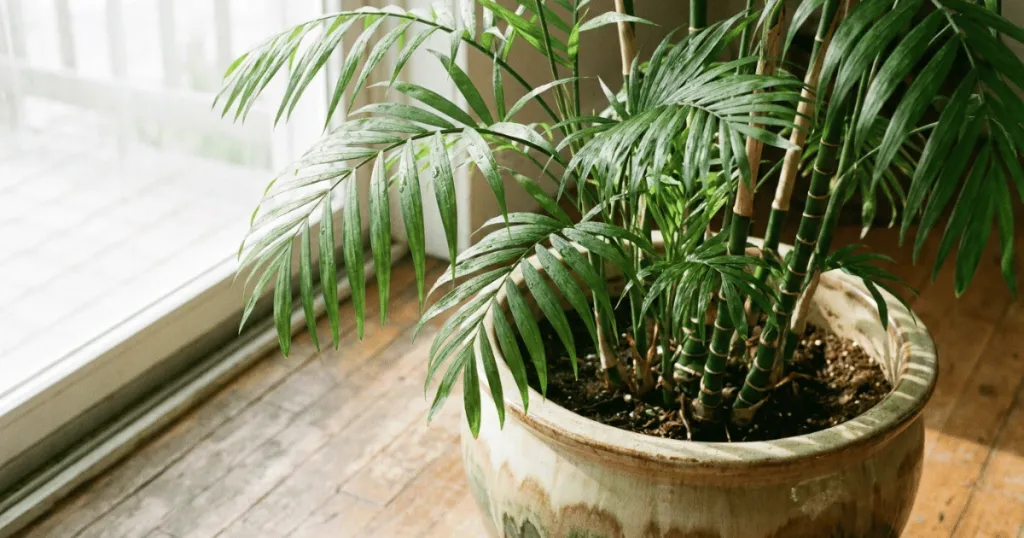
The bamboo palm is a champion of the indoor office because it does not require a south-facing window to survive. In fact, direct sunlight is often the enemy of this plant. When placed in direct sun, the leaves can bleach, develop unsightly yellow patches, or suffer from permanent tissue damage. Instead, position your plant in a spot that receives bright, indirect light. If your office has large windows with blinds, filtered light is ideal.
In many open-office layouts, fluorescent or LED overhead lighting provides the primary illumination. While the bamboo palm is shade-tolerant, it will grow much slower and look less vibrant if it is tucked into a dark corner with no natural light access. If your desk area is dim, consider placing the palm near a window that faces north or east, where the light is gentle. If you must rely entirely on artificial light, ensure the plant is close enough to the light source to receive a consistent glow for at least eight to ten hours a day. If you notice the plant leaning heavily toward one side, rotate the pot a quarter turn each week to encourage balanced growth.
Understanding the nuances of light intensity is vital for long-term plant health. In an office, light levels are often deceptive; what looks bright to the human eye may be insufficient for photosynthesis. If your bamboo palm shows signs of “stretching” or etiolation – where stems become thin and leaves grow further apart – it is a clear signal that the plant is searching for more light. In such cases, moving the plant closer to a window or supplementing with a dedicated full-spectrum LED grow bulb can stabilize its growth habit.
Watering and Soil Guidance
Watering is the most critical aspect of bamboo palm care. Because these plants are native to humid, tropical environments, they dislike being bone-dry. However, they are equally sensitive to waterlogged soil, which can lead to root rot. The goal is to keep the soil consistently and lightly moist. A good rule of thumb is to check the top inch of the soil with your finger before adding more water. If it feels dry to the touch, it is time to water.
In an office setting, HVAC systems often dry out the air and the soil rapidly. You may find that you need to water more frequently during the winter months when heating systems are running. Always ensure your pot has adequate drainage holes. If the plant is sitting in a decorative container without drainage, remove the nursery pot for watering and allow it to drain completely in a sink before returning it to the decorative vessel. Never let the plant sit in a saucer of standing water, as this will suffocate the roots and lead to yellowing fronds.
Regarding soil, use a high-quality, peat-based potting mix that provides good aeration. Adding a small amount of perlite or pumice to the mix can help improve drainage, ensuring that the roots have access to oxygen. Avoid heavy, garden-style soil, which compacts easily and retains too much moisture for a container-bound palm. For office managers, standardizing the potting medium across all office plants can simplify maintenance schedules. Using a consistent mix ensures that all plants in a department respond similarly to the same watering frequency, reducing the risk of human error during weekend or holiday breaks.
Humidity, Temperature, and Feeding
Office environments are notoriously dry due to climate control, which can be challenging for palms. While the bamboo palm is more resilient than other species, it appreciates extra humidity. If the air in your office is very dry, you might notice the tips of the leaves turning brown and crispy. To combat this, you can group plants together to create a micro-climate or use a small, desk-sized humidifier nearby. Misting the leaves is a common suggestion, but it provides only temporary relief and is less effective than active humidification.
Temperature-wise, these palms prefer the same conditions that humans find comfortable, typically between 65 and 80 degrees Fahrenheit. Avoid placing your palm directly in the path of an air conditioning vent or a heating duct. Sudden temperature fluctuations can stress the plant and cause it to drop leaves. Regarding fertilization, the bamboo palm is a light feeder. Use a balanced, water-soluble fertilizer diluted to half-strength during the growing season, which is typically spring and summer. Do not fertilize during the winter months when the plant enters a period of slower growth.
When managing office plant nutrition, avoid the temptation to over-fertilize. In an indoor environment, plants do not have the same metabolic rate as those in a greenhouse. Excess fertilizer salts can accumulate in the soil, leading to root burn. If you notice a white crust forming on the top of the soil, this is a sign of mineral buildup from either tap water or fertilizer. Flushing the soil with distilled or filtered water can help leach these salts out, preserving the health of the root system.
Repotting, Pruning, and Propagation
You will not need to repot your bamboo palm often. These plants actually prefer to be slightly root-bound, and frequent repotting can cause unnecessary stress. Repot only when you see roots growing out of the drainage holes or if the soil has degraded to the point where it no longer holds water properly. When you do repot, choose a container that is only one or two inches larger in diameter than the current one. Using a pot that is too large can lead to excess soil that stays wet for too long, increasing the risk of root rot.
Pruning is mostly a matter of aesthetics and plant health. As the plant matures, older fronds at the base may naturally turn yellow or brown. You can trim these off with clean, sharp shears to keep the plant looking tidy. Always cut close to the base of the stem. If you notice only the tips of the leaves are brown, you can trim the damaged portion back, but be careful not to cut into the healthy green tissue, as this can cause further browning.
Propagation of the bamboo palm is best achieved through division. When you repot the plant, you can gently separate the root ball into smaller clusters, ensuring each section has a healthy amount of roots and stems. This is a slow process, and the plant may take time to recover from the division, so it is usually best left to those with experience in plant care. In a professional setting, propagation is often used to expand the office’s greenery without additional costs, but it requires patience and a dedicated space for the new divisions to establish themselves.
Seasonal Notes and Common Care Mistakes
The biggest mistake in bamboo palm care is overwatering. Many office workers assume that because the plant is a palm, it needs constant saturation, but this is a fast track to root failure. Another common error is using water directly from a tap that is high in minerals or chlorine. If you notice white crusting on the soil surface, your tap water may be too hard. Letting the water sit out overnight before using it can help chlorine dissipate, though it does not remove minerals. Using filtered water is a safer approach if your building has particularly hard water.
During the winter, growth slows significantly. Adjust your watering schedule accordingly, allowing the soil to dry out slightly more than you would in the summer. Keep an eye out for pests like spider mites, which thrive in the dry, stagnant air of office buildings. Regularly wiping the leaves with a damp cloth not only keeps the plant looking professional but also helps remove dust and discourages pests from settling in. If you detect an infestation, isolate the plant immediately to prevent the spread to other office greenery.
Healthy growth in a bamboo palm looks like consistent, deep green foliage and the slow emergence of new, spear-like fronds from the center of the stems. If the plant is producing new growth, you know your care routine is working. If the growth stops or the stems become spindly, evaluate your light levels first, as this is the most common cause of a decline in vigor. By monitoring these subtle indicators, you can adjust your care routine proactively rather than reactively, ensuring your bamboo palm remains a vibrant part of the office landscape for years.
Strategic Integration into Office Design
Beyond individual care, the bamboo palm serves a functional role in office design. Its clustering habit allows it to act as a natural room divider or a privacy screen in open-plan offices. When arranging these palms, consider the mature size of the plant. While they grow slowly, they can eventually reach several feet in height and width. Providing adequate space for the plant to breathe is essential; crowding it against walls or furniture can restrict airflow, which increases the risk of fungal issues and pest outbreaks.
Furthermore, the psychological benefits of integrating plants like the bamboo palm into the workplace are well-documented in studies regarding workspace wellness. The presence of lush, green foliage can help soften the harsh lines of cubicle walls and reduce the visual noise of a busy office. By maintaining a healthy bamboo palm, you are not just caring for a plant; you are contributing to a more comfortable and productive environment for your colleagues. When the plant is healthy, it reflects a well-managed space, reinforcing the value of consistent, informed plant care practices.
Related Bamboo Palm Guides
- the Bamboo Palm plant guide
- why your Bamboo Palm might be struggling
FAQ
Is the bamboo palm safe for office pets?
Yes, the bamboo palm is considered non-toxic to cats and dogs according to ASPCA guidance. This makes it an excellent choice for offices that allow pets or for employees who are concerned about the safety of their animals at home. You can place it in common areas without worrying about common toxic reactions associated with other popular houseplants.
Why are the tips of my bamboo palm leaves turning brown?
Brown tips are usually a sign of low humidity or inconsistent watering. In an office, the air is often very dry due to HVAC systems. Try increasing the humidity around the plant or ensuring that you are not letting the soil dry out completely between waterings. If you are using tap water with high mineral content, that can also cause tip burn.
How often should I fertilize my bamboo palm?
You should only fertilize during the active growing season, which is spring and summer. Use a balanced, water-soluble fertilizer diluted to half-strength once every month or two. Avoid fertilizing in the autumn and winter, as the plant is in a dormant phase and does not need the extra nutrients, which could lead to salt buildup in the soil.
Can the bamboo palm survive in a windowless office?
While the bamboo palm is shade-tolerant, it cannot survive in a windowless room with no light. It requires either natural indirect light or a consistent, high-quality artificial light source. If your office has no windows, you must ensure the plant is placed directly under or very near a strong LED or fluorescent grow light that remains on for most of the workday to keep it healthy.