When desk plants start leaning dramatically toward the window or growing lopsided in a reception area, the issue usually points back to one directional force: phototropism. Indoor workspace conditions, particularly limited side-lighting from office windows or recessed ceiling fixtures, create strong directional light gradients. Because a plant’s cells elongate faster on the shaded side away from the light source, the stem bends toward the brightness over time. Understanding why and how often to rotate office plants for even growth helps maintain a balanced, professional aesthetic while supporting the long-term health of your workplace greenery.
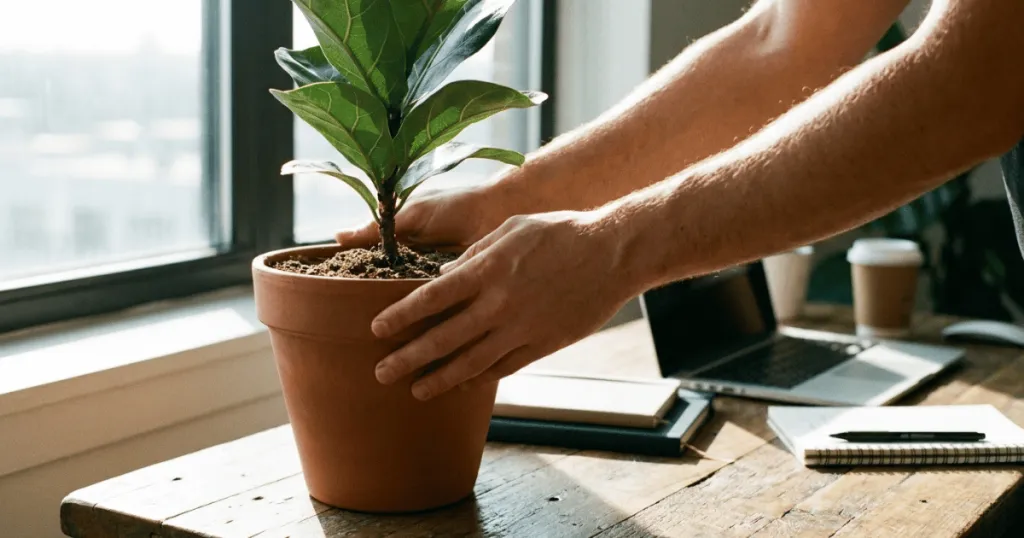
What This Means
Your office greenery requires physical repositioning every two to four weeks to counteract directional window lighting and maintain a symmetrical canopy, preventing structural weakness and lopsided foliage growth in professional settings.
The Mechanics of Directional Growth in Indoor Workspaces
Office environments present unique challenges for potted specimens compared to outdoor gardens or even residential sunrooms. Most indoor spaces rely on unilateral illumination. A desk situated near a perimeter window receives intense light from only one lateral angle. Even interior open-plan offices illuminated by commercial LED panels or fluorescent troffers often feature dead zones where light hits foliage unevenly. Understanding how to rotate indoor plants effectively requires looking closely at how architectural elements like glass partitions, metal file cabinets, and heavy window blinds interfere with ambient light distribution.
Auxin redistribution drives this natural response. Plant hormones known as auxins accumulate on the shaded side of a stem, stimulating rapid cell expansion and forcing the plant to lean toward the light source. Without regular physical intervention, this biological drive results in structural asymmetry. A specimen with all its weight concentrated on one side becomes top-heavy, risking structural instability in its container. Regular quarter-turns counteract this tendency, ensuring that every part of the foliage receives equal exposure to ambient light over the course of a month. This light intensity variation across an office floor makes plant positioning a vital part of standard office plant maintenance.
In addition to basic stem curvature, workplace lighting dynamics impact lower leaves differently than crown foliage. When a large floor plant stands near a floor-to-ceiling glass wall, the upper canopy intercepts most of the lumens, casting deep shadows over the lower stems and soil surface. This vertical gradient compounds the horizontal imbalance caused by side windows. Facilities personnel must analyze not just where the light enters the room, but how office furniture configurations, architectural columns, and security partitions break up that light stream. Addressing these complex exposure patterns requires deliberate spatial planning rather than haphazard positioning.
Establishing an Effective Rotation Schedule
Frequency depends heavily on the intensity of the light source and the active growth rate of the species. Fast-growing interior species such as pothos, heartleaf philodendron, and certain ferns require more frequent adjustments than slow-growing specimens like snake plants or cast-iron plants. Implementing a strict plant rotation schedule prevents uneven plant growth indoor and ensures predictable workplace biophilia management.
Standard Timeline for Common Office Environments
In bright perimeter offices with unobstructed glass, turning containers every two weeks keeps growth upright. In interior core zones relying strictly on overhead office lighting, a monthly schedule usually suffices because the light diffusion is more uniform, albeit weaker. During active spring and summer growth periods, plants respond much faster to light gradients, making bi-weekly turns essential. In contrast, during the dormant autumn and winter months, growth slows down significantly, allowing maintenance teams to stretch intervals to every six weeks without risking severe lopsidedness. Always monitor the growth rate of your office plant lighting conditions to tailor these intervals.
For office spaces subjected to artificial circadian lighting systems or extended HVAC operating hours, microclimatic shifts can trick indoor specimens into maintaining year-round active growth. In such environments, facilities managers should test a three-week rotation cycle and observe whether leaf orientation stabilizes. Documenting these intervals in a routine maintenance checklist prevents specimens from developing rigid, curved stems that resist future straightening.
The Quarter-Turn Technique
The method of turning matters just as much as the schedule. Twirling a container randomly often leads to missed quadrants. A systematic approach works best. Every time you water your office specimens or conduct routine maintenance, rotate the pot 90 degrees clockwise. This ensures that each of the four sides faces the primary light source for an equal quarter of the year. Marking the rim of the nursery pot or decorative cachepot with a small piece of painter’s tape on the north-facing side helps track your position cycle, protecting your investment in commercial interior landscaping.
When executing quarter-turns on heavy floor-standing planters, staff should lift or pivot the container carefully rather than dragging it across commercial carpeting or delicate office flooring. Using plant caddies equipped with low-profile caster wheels simplifies this physical task, encouraging compliance among administrative or maintenance personnel who might otherwise skip the chore due to heavy lifting constraints.
Real-World Context in Commercial Interiors
Consider a typical corporate meeting room featuring a large floor-standing fiddle-leaf fig positioned beside a floor-to-ceiling glass wall. Without intervention, the side facing the room remains sparse and pale while the window-facing side crowds with massive, overlapping leaves. By establishing a routine check where facilities staff or office managers turn the container ninety degrees during weekly office cleanups, the canopy develops evenly. This practice prevents the trunk from curving awkwardly and keeps the silhouette balanced within the architectural layout of the room, enhancing indoor biophilia.
Another common workplace scenario involves desk clusters beneath linear LED fixtures. While overhead lighting reduces lateral leaning compared to side windows, shadow casting from nearby acoustic panels or hanging pendant lights can still create uneven exposure. A pothos trailing from a high shelf or filing cabinet will quickly stretch its vines toward the aisle where ambient hallway light is stronger. Routine repositioning of trailing stems ensures uniform foliage density along the entire length of the vine rather than a bare crown, keeping window light gradients from ruining the aesthetic.
Consider also open-plan reception desks flanked by structural pillars and tinted glass doors. These transitional zones experience rapid shifts in natural glare throughout the day combined with artificial spotlighting from track fixtures. Desk-bound species placed in these high-traffic reception areas often develop erratic leaf orientation within a fortnight. Establishing a visual cue – such as aligning a specific decorative container marking with a desk corner every Friday afternoon – ensures that front-desk staff can maintain professional plant symmetry without disrupting daily client interactions.
Why Balanced Growth Matters for Plant Health and Longevity
Symmetry is not merely an aesthetic preference for interior design; it is a vital indicator of physiological health. When foliage grows heavily on one side, nutrient distribution and photosynthetic efficiency become unbalanced. The shaded side struggles to produce adequate energy, leading to premature yellowing and leaf drop. Furthermore, lopsided weight distribution places physical strain on the root system and stem base, occasionally causing the root ball to shift or snap within the potting mix.
Maintaining a balanced canopy also simplifies routine office care tasks such as dusting foliage and checking soil moisture. When leaves are evenly distributed, water reaches the root ball uniformly during irrigation, and pests like spider mites or scale find fewer hidden, low-light pockets to colonize. Professional workplace standards rely on vibrant, resilient greenery, and proactive light management protects your investment in office biophilia. Monitoring canopy balance ensures long-term stability.
From an operational standpoint, structural balance reduces the risk of tip-overs in busy corridors or breakout zones. When a tall office plant leans heavily to one side, its center of gravity shifts past the boundary of the pot rim. A minor bump from a passing cart or cleaning crew can send the entire heavy container crashing down. Regular rotation ensures that root expansion and top growth remain centered directly over the container’s base of support, mitigating workplace safety hazards.
Common Misconceptions About Plant Rotation
Several persistent myths surround the physical management of indoor greenery in commercial spaces. Clearing up these misunderstandings prevents well-meaning staff from accidentally damaging their workplace plants.
The Myth of Constant Daily Turning
A frequent error is believing that turning a container a little bit every single day produces superior results. In practice, constant daily manipulation stresses the plant. Reorienting foliage daily forces the stem to constantly adjust its growth direction, wasting metabolic energy that should go toward leaf development and root health. Stick to structured intervals of two to four weeks rather than daily adjustments.
Ignoring Seasonal Growth Shifts
Another oversight is maintaining the exact same rotation frequency year-round. Growth rates fluctuate dramatically based on indoor HVAC cycles and natural daylight hours filtering through building windows. Failing to slow down rotations in winter or speed them up during peak summer growth can leave plants struggling to adapt to changing indoor microclimates.
Assuming All Species Respond Identically
Treating every desk plant the same way leads to poor outcomes. Low-light tolerant species like ZZ plants require minimal attention regarding light orientation, whereas sun-loving specimens demand strict adherence to a rotation schedule. Always evaluate the specific light requirements of each species before locking in a maintenance routine.
Another subtle pitfall involves assuming that all stems within a multi-stem container will react uniformly. Clumped office specimens often feature dominant stems on the exterior side and weaker stems crowded in the interior. Turning the pot shifts which stems experience maximum exposure, but office managers must also prune away choked interior growth to allow air circulation and light penetration into the core of the plant.
FAQ
Can rotating office plants too frequently harm them?
Yes. Constantly shifting a container every day forces the plant to waste metabolic energy readjusting its stems toward the light source, which can stunt overall growth and cause leaf drop.
Should I rotate plants that live under fluorescent or LED office lights?
Even with overhead commercial lighting, side shadows from walls, partitions, or neighboring furniture create uneven light exposure, so turning pots every three to four weeks remains beneficial.
How can I remember when to rotate my office plants?
Tie the rotation schedule to your routine watering day. Every time you check soil moisture, give the container a simple ninety-degree turn to keep track of the cycle easily.
Do trailing plants on office shelves need to be rotated?
Trailing specimens with rooted crowns should still be turned periodically to prevent the top growth from becoming sparse, though the hanging vines themselves can be gently rearranged for aesthetic balance.