If you notice your office areca palm looking less than vibrant, the fastest and lowest-risk step is to check the soil moisture and the proximity to air vents. Before assuming the plant is dying, verify that the soil has not dried out completely, as these palms prefer consistent, light moisture. Simultaneously, ensure the plant is not sitting directly in the path of a forced-air HVAC vent, which can cause rapid dehydration and leaf browning regardless of how much you water. Addressing these two environmental factors often resolves the most common stressors immediately.
Areca palms are popular in professional spaces for their lush, feathery fronds, but they are sensitive to the specific conditions of modern office buildings. Unlike outdoor palms that thrive in humid, tropical environments, office-grown areca palms frequently struggle with low humidity, inconsistent watering, and restricted light. Understanding these limitations is the first step toward maintaining a healthy specimen in your reception area or meeting room.
Short Answer
Most areca palm problems stem from inconsistent watering or low humidity. To fix these, keep the soil lightly moist at all times, avoid letting it dry out, and ensure the plant receives bright, indirect light away from direct HVAC airflow to prevent frond browning and drooping.
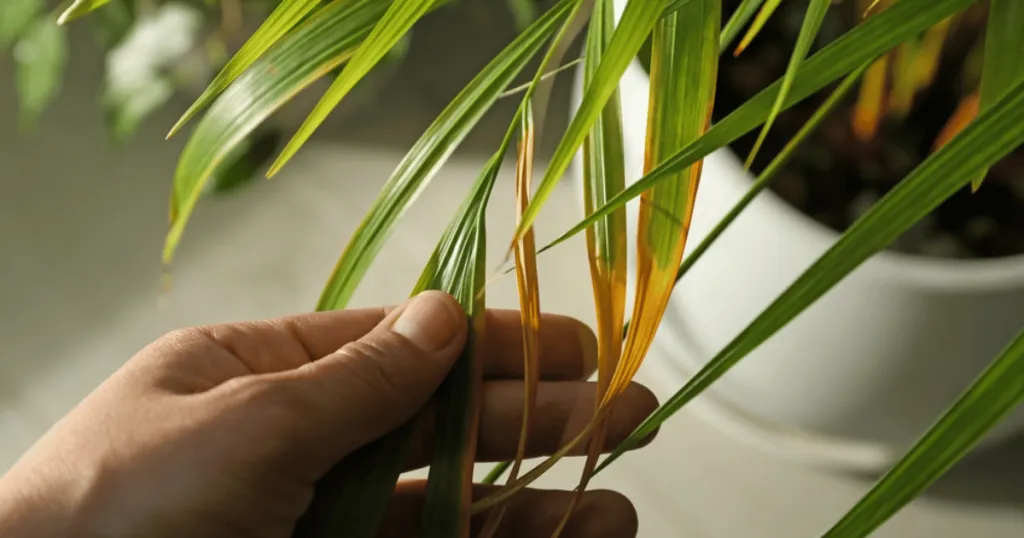
Common Symptom Diagnosis
Troubleshooting plant issues in an office requires a systematic approach. Use the following table to identify the most likely cause based on the visual symptoms you see on your palm.
| Symptom | Most Likely Cause | Primary Fix |
|---|---|---|
| Brown, crispy leaf tips | Low humidity or underwatering | Increase humidity or adjust watering frequency |
| Yellowing lower fronds | Overwatering or poor drainage | Check soil moisture and ensure pot drainage |
| Drooping or wilted fronds | Severe thirst or root stress | Deep soak and move away from heat vents |
| Stalled growth | Insufficient light | Move to a brighter, indirect light location |
| Webbing or sticky residue | Pest infestation | Wipe leaves with diluted soap solution |
Addressing the Most Common Areca Palm Problems
The most frequent issues with areca palms are almost always tied to water management and environmental stability. Because offices are typically climate-controlled with dry, recycled air, the plant is under constant pressure to lose moisture through its leaves.
Managing Watering Inconsistencies
The areca palm requires a delicate balance. It is not a desert plant, nor is it a bog plant. If the soil dries out completely, the tips of the fronds will turn brown and brittle almost immediately. Conversely, if the plant sits in standing water, the roots will begin to suffocate and rot, which manifests as yellowing fronds that eventually turn mushy. In an office, the best practice is to check the top two inches of soil twice a week. If it feels dry to the touch, it is time to water. Always ensure the pot has drainage holes so excess water can escape, as sitting water is the fastest way to kill this species.
When managing watering in a shared office space, communication is key. If multiple staff members have access to the plant, it is common for the palm to be overwatered by well-meaning individuals. Implementing a simple “watered on [day]” tag or a shared digital log can prevent the root rot associated with over-saturation. Remember that during winter months, when the office heating system is running, the plant’s water needs may actually increase due to the drying effect of the air, even if the plant’s growth rate slows down.
Combatting Low Humidity
Office environments are notoriously dry due to HVAC systems. Areca palms, which are native to humid tropical regions, struggle when the relative humidity drops below 40 percent. This dryness is the primary culprit behind the brown, crispy tips that many office managers observe. While you cannot change the building’s climate control, you can create a microclimate. Grouping plants together can help, as can placing the palm on a tray of pebbles filled with water. Ensure the bottom of the pot is not touching the water directly to avoid root rot. This simple adjustment creates a small buffer of humidity around the foliage.
Beyond pebble trays, consider the placement of the plant relative to the building’s air circulation. If the palm is positioned directly under an air diffuser, the constant airflow will strip moisture from the fronds faster than the roots can replenish it. Relocating the plant just a few feet away from the direct path of the air can significantly reduce the frequency of brown tips and improve the overall appearance of the foliage.
Advanced Troubleshooting and Care Adjustments
When basic watering and humidity fixes do not resolve the issue, you may need to look at light levels or potential pest activity. Areca palms are one of the more light-demanding indoor palms. If your plant is tucked into a dark corner or a windowless hallway, it will eventually stop producing new growth and may begin to shed older fronds prematurely. While they do not need direct, scorching sunlight, they do require bright, indirect light to maintain their metabolic health.
Evaluating Light Exposure
If your palm is struggling, assess the light quality. Is it near a window, or is it relying entirely on overhead fluorescent lighting? If the latter, the plant is likely light-starved. Moving the plant closer to a window, even if it is behind a sheer curtain, can make a significant difference. If moving the plant is not an option, consider whether the current location is truly bright enough for a palm. If the plant is consistently failing, it may be time to rotate it to a location with better natural light exposure.
In office settings, light intensity often drops off significantly as you move away from the window. A palm that looks healthy three feet from a window may struggle at six feet. Use a light meter or a smartphone app to gauge the foot-candles if you are unsure, but generally, if you can comfortably read a book in the location without artificial light, it is a good starting point for an areca palm. If the plant is leaning heavily toward a light source, it is a clear indicator that it needs to be rotated regularly to ensure even growth and prevent the plant from becoming lopsided.
Identifying and Treating Pests
In the quiet, stable environment of an office, pests like spider mites can sometimes go unnoticed until they have caused visible damage. Spider mites thrive in the same dry, warm conditions that are common in office buildings. Look for fine, silk-like webbing between the leaflets or tiny yellow stippling on the fronds. If you find these, isolate the plant to prevent the spread to other office greenery. A gentle wipe-down of the fronds with a damp cloth and a mild, diluted soap solution is often enough to manage early-stage infestations. Avoid harsh chemical pesticides in an office setting, as they can be disruptive to the workplace environment.
Scale insects are another potential issue for indoor palms. These appear as small, brown, bump-like protrusions on the stems or the undersides of the leaves. Unlike spider mites, they do not create webs, but they do suck sap from the plant, leading to stunted growth and yellowing. If you spot these, they can often be removed manually with a cotton swab dipped in rubbing alcohol. Regular inspection during your routine maintenance check is the best defense against both mites and scale, as these pests are much easier to manage when caught early.
Prevention Habits for Long-Term Success
Prevention is significantly easier than recovery. Establishing a routine ensures that the areca palm remains a decorative asset rather than a maintenance burden. One of the most effective habits is to designate a specific person or team responsible for checking the soil moisture on a set schedule. This prevents the common cycle of over-watering on Monday and forgetting the plant entirely until the following week.
Another vital habit is regular cleaning. Dust accumulation on the fronds can block light and prevent the plant from photosynthesizing effectively. Every few weeks, use a damp cloth to gently wipe the leaves. This not only keeps the plant looking professional but also allows you to inspect the foliage closely for any early signs of pests or disease. Finally, avoid fertilizing during the winter months when the plant is in a state of reduced growth. Over-fertilizing during this period can lead to salt buildup in the soil, which causes further browning of the leaf tips.
When selecting a location for your areca palm, consider the long-term traffic patterns of the office. These palms have wide, arching fronds that can be easily damaged if they are in a high-traffic area where people frequently brush against them. Place the palm in a corner or a dedicated plant zone where it can spread out without being disturbed. This physical protection helps maintain the integrity of the fronds and reduces the mechanical stress that can lead to leaf tearing and premature browning.
Finally, consider the pot and soil medium. If you have inherited a palm in a decorative container without drainage, it is highly recommended to repot it into a plastic nursery liner that fits inside the decorative pot. This allows you to remove the plant for watering, ensuring that excess water drains away completely before the plant is returned to its display location. Using a well-draining potting mix specifically designed for palms or adding perlite to standard indoor potting soil can further improve aeration and reduce the risk of root rot, which is a common, often fatal, issue for indoor palms.
By maintaining a consistent environment and performing regular, light maintenance, you can mitigate most of the risks associated with indoor palm care. Remember that the areca palm is a living organism that responds to its surroundings; by providing stable light and moisture, you create the conditions necessary for it to thrive in your workspace.
Related Areca Palm Guides
FAQ
Are areca palm problems related to pet safety?
No. According to the ASPCA, the areca palm is non-toxic to both cats and dogs. If your palm is showing signs of distress, it is likely an environmental issue rather than a toxicity concern, and you do not need to worry about the plant harming office pets.
Why are the tips of my areca palm turning brown?
Brown tips are almost always a sign of low humidity or inconsistent watering. In an office, the dry air from HVAC systems is the most common cause. Increasing the humidity around the plant or ensuring the soil stays consistently moist can help prevent further browning.
Can I trim the brown tips off my areca palm?
Yes, you can trim the brown tips for aesthetic reasons. Use clean, sharp scissors to cut just outside the green tissue, leaving a tiny sliver of brown. Avoid cutting into the healthy green part of the leaf, as this can cause further stress to the plant.
How do I know if my areca palm is getting enough light?
A healthy areca palm should show steady, slow growth. If the plant is not producing new fronds or if the existing fronds are becoming thin and pale, it is likely not receiving enough light. Move the plant to a brighter location with more indirect natural light.